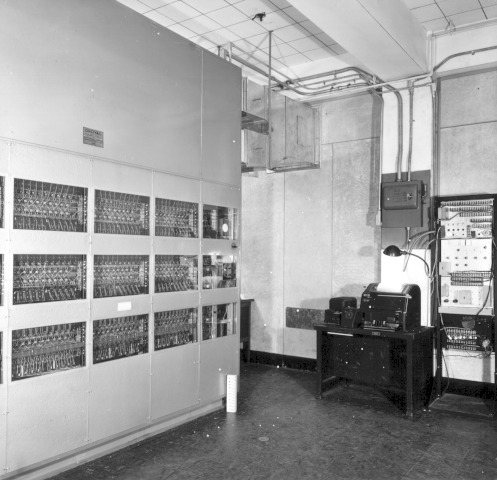
 Under construction! pictures and more materials will be added.
The goals of this project are:
1) Learn, understand, document the design of ORDVAC.
2) Build a portion of ORDVAC and interface it with computer
Why? Well, I love electron tubes. I love
computers. I love history. You got the idea.
I began to look into a lot of 1st generation computers. Since I am a
student at U of I, it is natural to pay attention to ILLIAC I. Surprisingly
very little have survived regarding the design of the hardware. It is very
hard to find information on tube-based logic circuits.
One day, out of whim, I sent e-mail to Prof. Sylvian Ray whom I have taken
a course from long time ago. He is origianlly an EE guy, but has been into
AI for long time now. It turned out, he was actually at the Aberdeen
Probing Ground (BRL) where ENIAC, EDVAC and ORDVAC were operating. He was
in charge of taking care of ORDVAC, a clone of ILLIAC I, designed and
manufactured by the U of I. (They were not exactly clones, but close enough)
Prof. Ray had a copy of ORDVAC manuals which contain circuit diagrams and
detailed operational princicples. I borrowed them and eventually made PDF
files. Here they are:
ORDVAC Manual Volume I, ORDVAC Manual Volume II.
The first polished design of Von Neumann computer was so-called IAS machine.
At the Institute for Advanced Studies at Princeton, John von Neumann and
colleagues designed it. It became operational in 1952. Based on their
design many others made similar computers. U of I started building two in
1949 and completed ORDVAC in 1951. In 1952, it was delivered to BRL where
ENIAC and EDVAC were installed. ILLIAC I was completed in 1952. So ORDVAC
is one of the fisrt IAS machines.
ORDVAC went through a series of make-over in the subsequent years until its
retirement in mid 60s. One of the most significant change was the memory.
It originally had Williams tube based memory system which was better than
EDVAC's mercury delay line but still not very reliable. The BRL engineers
"upgraded" it to the magnetic core memory. It took less space and power,
and much more reliable. They also transisterized the arithmetic unit.
The electron tube-based computers were not so reliable. If you "cold" start
the computer, there are 25 to 50% chance of operating correctly.